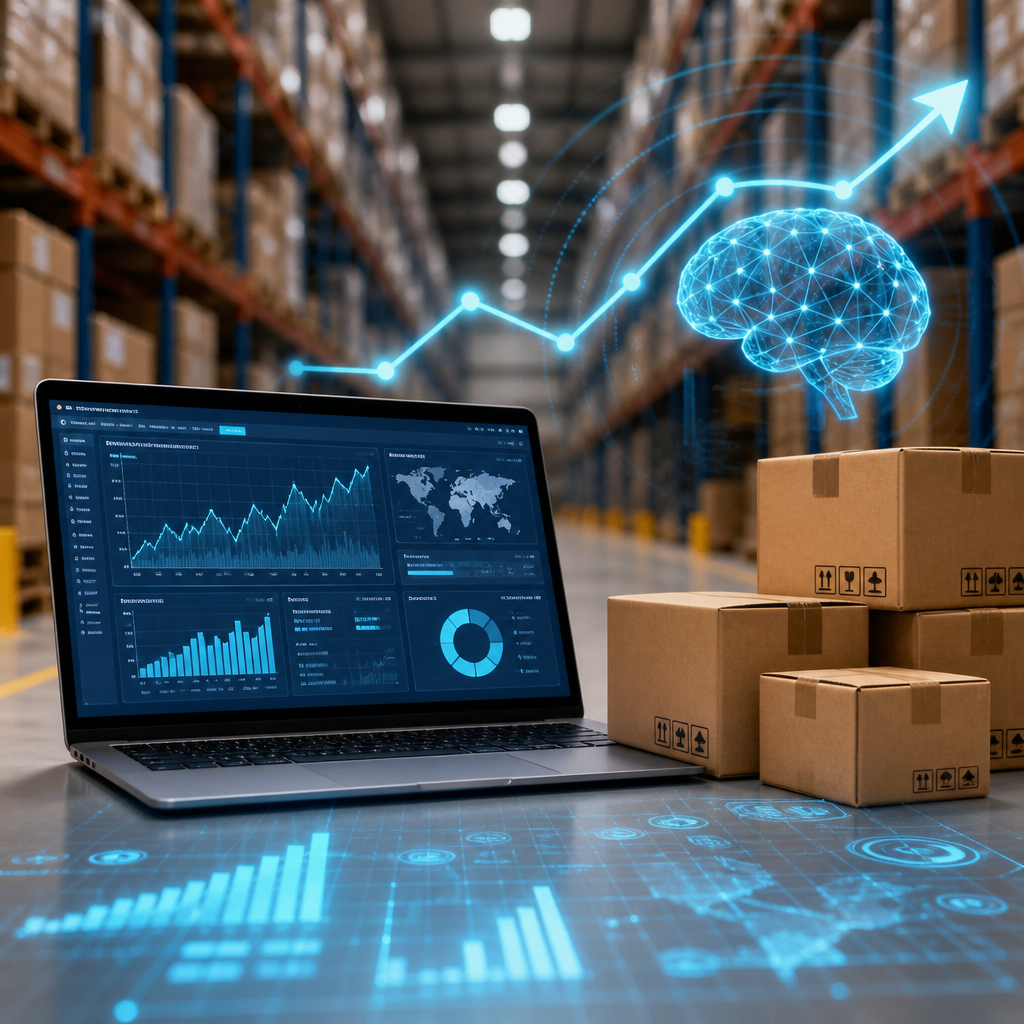
Inventory Forecasting AI: Eliminating $500K Stockouts
October 27, 2026
The Hidden Cost of Getting Inventory Wrong
Every business that moves physical products lives with a quiet tension: too much stock ties up cash, while too little sends customers straight to competitors. Industry research consistently estimates that retailers lose close to 4% of annual revenue to stockouts, and for a mid-sized business, that easily climbs past $500,000 per year. At the same time, overstock drains margins through storage costs, markdowns, and write-offs.
Traditional spreadsheets and static reorder points were built for a slower, more predictable market. Today, demand shifts with a viral social post, a competitor’s flash sale, or a heatwave in a key region. This is exactly where inventory forecasting AI changes the equation, turning guesswork into continuous, data-driven decisions.
How Inventory Forecasting AI Actually Works
Machine learning models ingest your historical sales data and look for patterns that human planners simply cannot see at scale. Instead of relying on a single average, the algorithms evaluate thousands of SKU-and-location combinations simultaneously. They then generate probabilistic forecasts that tell you not just what is likely to sell, but how confident the system is in that prediction.
Signals That Drive Accurate Demand Prediction
Modern demand prediction software blends internal and external data to sharpen its accuracy. The most valuable inputs typically include:
- Seasonal trends: weekly, monthly, and annual cycles, including holiday shifts that move year to year.
- Marketing campaigns: planned promotions, email sends, and ad spend that create demand spikes.
- Weather data: temperature and precipitation patterns that influence categories from beverages to apparel.
- Economic indicators: consumer confidence, inflation, and regional spending shifts.
- Supplier signals: lead-time variability, shipping delays, and minimum order constraints.
The model continuously retrains as new sales data arrives, so forecasts improve over time rather than decaying like a static plan. This self-correcting behavior is what separates true AI inventory management from conventional reporting dashboards.
Preventing Stockouts Without Creating Overstock
The real power of predictive stock optimization lies in balancing two competing risks at once. Rather than padding safety stock across the board, AI calculates the ideal buffer for each product based on its demand volatility and supplier reliability. A stable, high-margin staple might need a thin buffer, while a trend-sensitive item with long lead times requires more protection.
From Forecasts to Automated Reordering
Forecasts only create value when they trigger action. Automated reordering systems translate predictions into purchase orders or replenishment suggestions, routed for approval or sent automatically within rules you define. Planners shift from firefighting and data entry to managing exceptions and negotiating with suppliers.
Typical outcomes businesses report after deployment include:
- 20% to 50% reduction in stockout incidents.
- 10% to 30% decrease in excess inventory carrying costs.
- Fewer emergency shipments and expedited freight charges.
- Higher on-shelf availability during peak campaigns.
A Realistic Case Study: ROI in Under Six Months
Consider a regional retailer with roughly 8,000 SKUs across 12 locations, struggling with frequent stockouts on its top 300 sellers. Before AI, planners used rolling averages and manual adjustments, leaving about $520,000 in annual lost sales from out-of-stock events, plus aging inventory that required deep discounting. After a three-month implementation, the retailer connected its sales history, promotional calendar, and supplier lead times to a forecasting engine.
Within six months, stockout-related lost sales dropped by more than 60%, while slow-moving inventory fell by roughly 22%. The combined gains in recovered revenue and freed working capital exceeded the project investment well before the half-year mark. You can explore similar measurable outcomes in our case studies.
Implementation Strategy for Retailers and Manufacturers
Successful adoption is less about buying a tool and more about following a disciplined rollout. A phased approach limits risk and builds internal confidence quickly. Here is a proven sequence:
- Audit your data: clean historical sales, returns, and stock-level records, and identify gaps in promotional and supplier data.
- Start with a pilot: select one category or location where stockouts are most costly and measure a clear baseline.
- Integrate with your ERP: connect forecasting outputs to your existing ERP, WMS, or e-commerce platform through APIs so recommendations flow into daily workflows.
- Define business rules: set service-level targets, minimum order quantities, and approval thresholds for automated purchasing.
- Measure and expand: track forecast accuracy, fill rate, and inventory turns, then scale to additional categories and sites.
Integrating With Your Existing Systems
A common fear is that AI requires ripping out your current ERP, but modern supply chain AI is designed to sit on top of existing infrastructure. Custom integrations pull data from platforms like SAP, NetSuite, Microsoft Dynamics, Magento, or Shopify, then push recommendations back automatically. For businesses running complex, multi-system environments, our team handles this connective tissue through tailored AI-powered automation services.
Common Pitfalls to Avoid
Even strong technology can underperform when the groundwork is neglected. Watch for these frequent mistakes:
- Feeding the model poor-quality or incomplete data and expecting accurate output.
- Ignoring planner expertise instead of combining human judgment with machine predictions.
- Skipping change management, which leaves teams distrusting automated recommendations.
- Measuring success only by forecast accuracy rather than business outcomes like revenue recovered and cash released.
Treat the first quarter as a learning phase, reviewing exceptions weekly and tuning parameters as the system learns your business rhythms.
Summary: Turn Inventory Into a Competitive Advantage
Stockouts and overstock are not inevitable costs of doing business; they are solvable problems rooted in outdated forecasting methods. Inventory forecasting AI analyzes seasonality, campaigns, weather, and economic signals to predict demand with far greater precision, then automates replenishment to protect revenue and free up cash. With a phased rollout and clean integration into your ERP, most businesses see measurable ROI within six months.
If you are ready to stop losing sales to empty shelves, explore our dedicated AI inventory forecasting and optimization solution, or review our full range of digital services to see how we build systems that drive measurable growth.