AI-Powered A/B Testing: 10x Faster Optimization Results
June 25, 2026
The Evolution Beyond Traditional A/B Testing
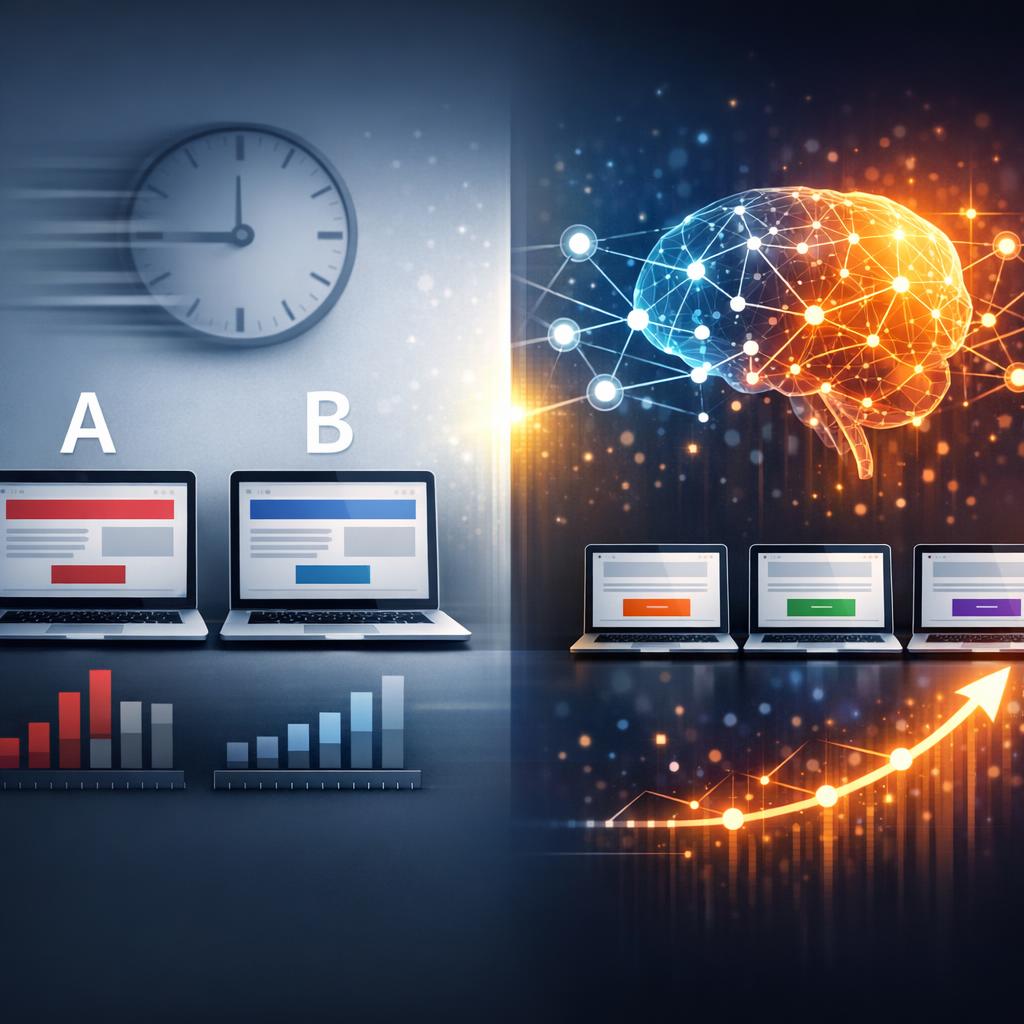
Traditional A/B testing has served marketers well for decades, but it comes with significant limitations that cost businesses time and money. A standard two-variant test typically requires 4-6 weeks to reach statistical significance, assuming you have sufficient traffic. For businesses testing multiple hypotheses across different pages, this timeline quickly becomes unsustainable. The digital landscape moves too fast for month-long experiments that test only two variations at a time.
Enter AI-powered A/B testing—a paradigm shift that leverages machine learning algorithms to compress months of optimization into days. Unlike traditional methods that split traffic evenly between variants until a winner emerges, AI-driven systems use multi-armed bandit algorithms to dynamically allocate traffic toward better-performing variations in real-time. This approach doesn’t just speed up testing; it fundamentally transforms how businesses approach conversion rate optimization. Companies implementing AI testing report 10x faster results while simultaneously reducing the opportunity cost of showing underperforming variants to valuable visitors.
The difference becomes stark when you consider scale. While traditional testing limits you to comparing two or three variants, AI systems can evaluate 50+ variations simultaneously, identifying winning combinations across headlines, images, calls-to-action, and layout elements. This exponential increase in testing capacity means businesses can explore the optimization landscape more thoroughly and discover high-impact improvements that would take years using conventional methods.
How Machine Learning Transforms Optimization
AI-powered testing platforms employ sophisticated machine learning algorithms that go far beyond simple traffic splitting. These systems continuously analyze visitor behavior patterns, segment performance, and contextual factors to make intelligent decisions about which experiences to serve. The technology operates on three fundamental capabilities that traditional testing cannot match: automatic traffic allocation, advanced pattern recognition, and real-time adaptation.
Automatic traffic allocation uses Bayesian statistical models rather than frequentist approaches. Instead of waiting for absolute certainty before declaring a winner, Bayesian methods calculate the probability that each variant is optimal and shift traffic accordingly. If Variant B shows a 78% probability of outperforming Variant A after just 500 visitors, the system immediately begins sending more traffic to Variant B while continuing to monitor performance. This approach maximizes conversions during the testing phase itself—something impossible with traditional fixed-split testing.
Pattern recognition capabilities allow AI systems to identify which visitor segments respond best to specific variations. The algorithms automatically detect that mobile users from paid search convert better with shorter forms, while organic desktop visitors prefer detailed product information. These insights emerge without manual segmentation, and the system applies them instantly. Advanced platforms can even generate new hypotheses by analyzing your analytics data, suggesting test variations based on behavioral patterns humans might miss.
Key AI Testing Advantages
- Multi-variant capability: Test 20-50+ variations simultaneously versus traditional 2-3 limit
- Speed to significance: Reach actionable conclusions in days instead of weeks or months
- Reduced opportunity cost: Minimize traffic exposure to underperforming variants
- Automatic personalization: Serve optimal experiences to different visitor segments without manual rules
- Continuous learning: Systems improve over time as they process more behavioral data
Leading Platforms and Implementation Strategies
The AI testing landscape has evolved significantly, especially since Google Optimize sunset in 2023. Today’s leading platforms include Optimizely, VWO, Dynamic Yield, and AB Tasty, each offering distinct approaches to machine learning optimization. Optimizely’s Stats Engine uses Bayesian statistics to deliver results up to 50% faster than traditional methods, while VWO’s SmartStats automatically adjusts for multiple comparisons and provides continuous monitoring without fixed test durations.
Dynamic Yield takes personalization further by combining AI testing with experience optimization across channels. Their algorithms don’t just identify winning variants—they automatically create personalized experiences for micro-segments based on behavior, context, and predicted intent. This level of sophistication represents the future of conversion optimization, where testing and personalization merge into a single, continuously improving system. For enterprises handling complex customer journeys, these capabilities deliver ROI that justifies premium pricing.
Implementation success depends on three critical factors: sufficient traffic volume, proper technical integration, and high-quality data. AI algorithms require meaningful sample sizes to identify patterns—generally 1,000+ conversions monthly as a baseline. Technical integration must be seamless to avoid page load delays that undermine the conversions you’re trying to improve. Data quality matters enormously; if your analytics tracking has gaps or your conversion events aren’t properly defined, even the most sophisticated AI will produce unreliable results. AI-powered automation services can help ensure your testing infrastructure is properly configured for optimal performance.
Real-World Results and ROI Considerations
An enterprise e-commerce client implemented AI-powered testing after years of traditional A/B experiments. Their previous approach tested 2-3 product page variations monthly, requiring 6 weeks per test cycle. After switching to an AI platform, they simultaneously tested 42 combinations of product images, descriptions, social proof elements, and CTA buttons. The system identified a winning combination in 11 days that increased add-to-cart rates by 34%—an improvement they estimate would have taken 14 months to discover using their previous methodology.
The financial implications extend beyond faster results. Consider the opportunity cost: if your traditional test shows 50% of traffic an inferior variant for 6 weeks, you’re sacrificing conversions throughout the testing period. AI systems minimize this waste by rapidly shifting traffic toward winners. For a site generating $500,000 monthly revenue with a 3% conversion rate, reducing testing time from 6 weeks to 10 days while minimizing exposure to poor variants can preserve $50,000-$75,000 in revenue per test cycle.
Platform costs typically range from $2,000-$10,000+ monthly depending on traffic volume and feature requirements. Enterprise solutions with advanced personalization capabilities can exceed $50,000 annually. However, businesses running continuous optimization programs often achieve 15-30% conversion rate improvements within the first year, making ROI calculation straightforward. A company with $3 million annual online revenue needs just a 10% conversion improvement to justify a $30,000 annual platform investment.
Implementation Roadmap and Ethical Considerations
Transitioning from basic A/B testing to full AI optimization should follow a structured progression. Begin with simple multi-armed bandit tests on high-traffic pages to build confidence in the technology and establish baseline performance improvements. Once your team understands how AI allocation works, expand to multi-variant testing across multiple page elements. The third phase introduces automatic personalization, where the system serves different experiences to identified segments. Finally, implement predictive targeting that anticipates visitor intent and serves optimized experiences proactively.
This roadmap typically spans 6-12 months, allowing your organization to develop expertise while demonstrating incremental value. Start with pages that have sufficient traffic for quick learning—typically your homepage, primary product pages, or checkout flow. Avoid testing low-traffic pages initially, as AI algorithms need data volume to function effectively. Document your learnings throughout the process, as insights about what resonates with your audience will inform broader marketing strategies beyond just website optimization.
Ethical considerations and privacy compliance must guide your implementation. AI testing systems collect and analyze behavioral data, making GDPR, CCPA, and other privacy regulations directly applicable. Ensure your consent management platform properly covers testing activities, and be transparent about personalization in your privacy policy. Avoid testing strategies that could be perceived as manipulative, such as showing artificially inflated scarcity messages or dramatically different pricing to different segments. The goal is optimization that serves both business objectives and customer experience—not exploitation of behavioral vulnerabilities.
Summary: The Competitive Imperative of AI Testing
AI-powered A/B testing represents more than incremental improvement over traditional methods—it’s a fundamental shift in how businesses approach optimization. The ability to test dozens of variations simultaneously, reach statistical significance in days rather than months, and automatically personalize experiences for different visitor segments creates competitive advantages that compound over time. Companies still relying on traditional testing methodologies will find themselves perpetually behind competitors who iterate and improve 10x faster.
The technology has matured beyond early-adopter status. Platforms now offer accessible interfaces, robust statistical foundations, and proven ROI across industries. The question for business leaders isn’t whether to adopt AI testing, but how quickly they can implement it effectively. Start with a clear assessment of your current testing capabilities, traffic volumes, and organizational readiness. Choose a platform aligned with your technical sophistication and budget, then follow a structured implementation roadmap that builds expertise progressively.
The future of conversion optimization is already here—it’s just not evenly distributed yet. Forward-thinking organizations are capturing the advantages of AI-driven testing while their competitors continue running month-long experiments on two variants at a time. The performance gap this creates will only widen as AI systems accumulate more data and become more sophisticated. For CEOs and digital directors committed to staying competitive, investing in AI-powered optimization capabilities isn’t optional—it’s essential for sustainable growth in an increasingly digital marketplace.