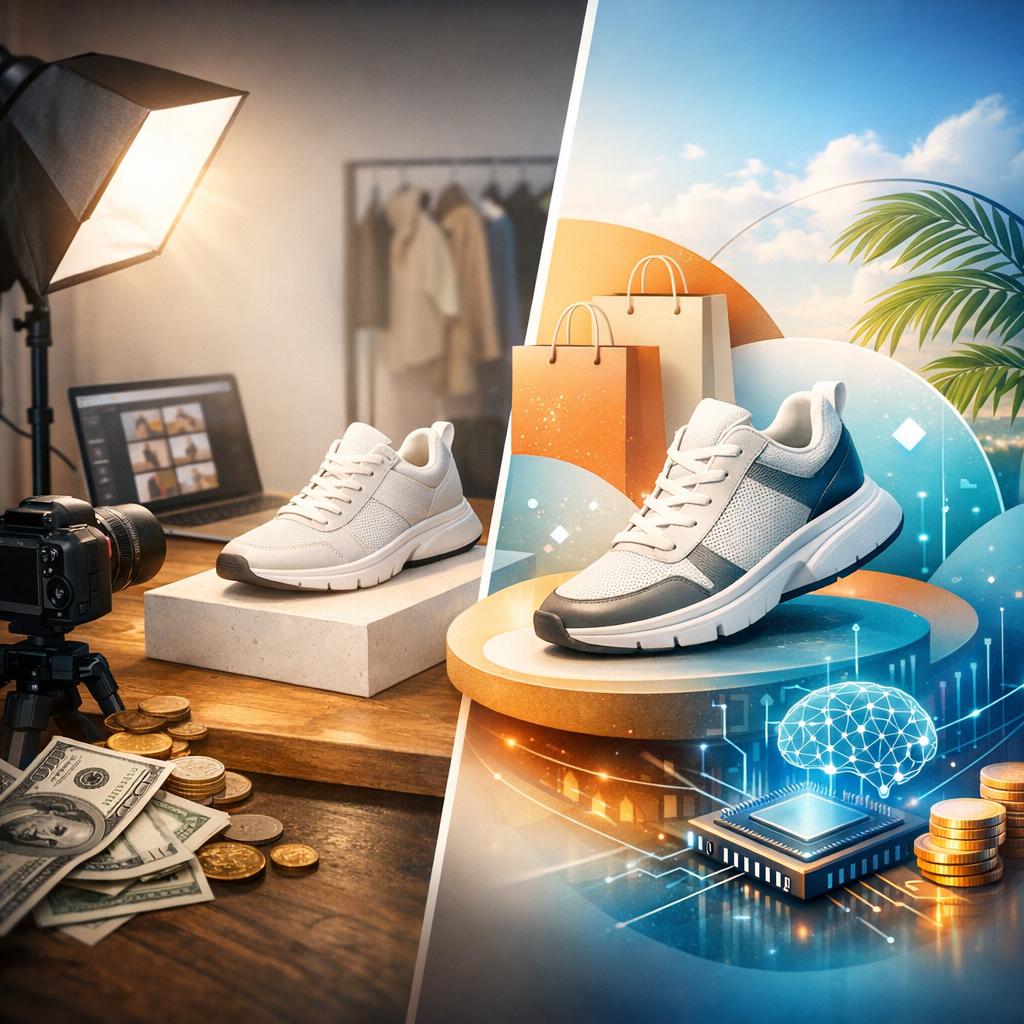
AI Image Generation for E-Commerce: The 2024 Cost Analysis
April 30, 2026
The Revolutionary Shift in E-Commerce Product Imagery
The e-commerce landscape is experiencing a seismic shift in how product images are created and deployed. Traditional product photography, with its hefty price tags ranging from $500 to $2,000 per product, is being challenged by AI image generation tools that cost as little as $30 per month. For business owners and decision-makers, this isn’t just about cost savings—it’s about operational agility, creative flexibility, and competitive advantage in an increasingly visual marketplace.
AI image generation platforms like Midjourney, DALL-E 3, and Stable Diffusion are enabling e-commerce brands to produce hundreds of lifestyle images, seasonal variations, and contextual backgrounds in days rather than months. However, the technology isn’t without limitations, and understanding when to use AI versus traditional photography is crucial for maintaining brand integrity and customer trust. This analysis provides a comprehensive framework for evaluating AI image generation as part of your e-commerce strategy.
The question isn’t whether AI will replace traditional product photography entirely, but rather how savvy businesses can leverage both approaches to maximize ROI while maintaining quality standards. Let’s examine the real-world costs, capabilities, and strategic considerations that should inform your decision-making process.
Cost Comparison: Traditional Photography vs AI Generation
Traditional product photography involves substantial upfront and ongoing costs that extend far beyond the photographer’s fee. A typical product shoot includes studio rental, lighting equipment, props, models, styling, post-production editing, and project management. For a mid-sized e-commerce brand launching 50 new products quarterly, photography costs alone can exceed $50,000 annually. Add rush fees for seasonal campaigns, and budgets quickly spiral beyond what many businesses can sustain.
AI image generation presents a dramatically different cost structure. Midjourney’s standard subscription costs approximately $30 monthly, while DALL-E 3 operates on a credit system averaging $40-60 for extensive use. Stable Diffusion offers open-source alternatives with minimal costs beyond computing resources. The economic advantage becomes staggering when producing variations: creating 20 different lifestyle contexts for a single product might require $10,000-15,000 in traditional photography but costs essentially nothing additional with AI once you’ve mastered prompt engineering.
However, the true cost analysis must account for time investment in learning prompt engineering, quality control processes, and the hybrid workflow most businesses ultimately adopt. A realistic budget includes 20-40 hours of initial training, ongoing quality assurance, and traditional photography for hero shots and products requiring precise accuracy. The ROI framework should measure not just direct cost savings but also speed-to-market improvements and A/B testing capabilities that AI enables.
Key Cost Factors to Consider
- Traditional photography: $500-2,000 per product for initial shots, $200-800 for lifestyle variations
- AI generation: $30-60 monthly subscription, minimal marginal cost per image
- Hybrid approach: $300-500 per product for hero photography plus AI for variations
- Time investment: 6-month traditional timeline vs 2-week AI-assisted production
- Scalability: Linear cost increases (traditional) vs flat subscription costs (AI)
Strategic Use Cases and the Hybrid Approach
The most successful e-commerce implementations don’t view AI image generation as an either-or proposition. Instead, leading brands are adopting a hybrid approach that leverages the strengths of both methods. The strategy involves photographing the actual product with professional equipment to ensure color accuracy, texture representation, and detail clarity, then using AI to generate diverse backgrounds, lifestyle contexts, and seasonal variations around that core product image.
This hybrid methodology proved transformative for a furniture retailer that needed to showcase products in various room settings and design styles. Traditional photography would have required building multiple room sets and conducting extensive shoots across 6 months. Instead, they photographed each furniture piece once with proper lighting and angles, then used Midjourney to generate over 500 lifestyle images showing products in modern apartments, traditional homes, minimalist offices, and seasonal contexts—all completed within two weeks.
The hybrid approach excels in several specific use cases. Seasonal marketing campaigns benefit enormously from AI’s ability to place products in holiday, summer, or back-to-school contexts without new photo shoots. A/B testing becomes economically viable when you can generate 10 different background variations in minutes rather than commissioning separate shoots. Geographic customization allows brands to show products in culturally relevant contexts for different markets without international photography expeditions.
Midjourney Workflow and Quality Considerations
Implementing AI image generation effectively requires understanding the workflow and current technological limitations. Midjourney, currently the market leader for photorealistic commercial imagery, operates through a Discord interface that initially confuses many business users but offers powerful capabilities once mastered. The process begins with prompt engineering—crafting detailed text descriptions that specify product placement, lighting conditions, background elements, style references, and compositional requirements.
Quality considerations remain significant. AI image generation currently struggles with text rendering, making it unsuitable for products where packaging text or labels must be readable. Specific product accuracy varies; while AI excels at creating generic furniture or apparel in lifestyle settings, it cannot reliably reproduce exact product details, patterns, or brand-specific design elements. This limitation reinforces why the hybrid approach—photographing the actual product and AI-generating contexts—produces superior results for most e-commerce applications.
Consistency across a product line requires developing a prompt library that maintains brand style guidelines. Successful implementations document effective prompts, including specific style references, lighting descriptors, and compositional elements that align with brand aesthetics. This systematization transforms AI generation from experimental to production-ready, enabling team members to produce on-brand imagery reliably. For businesses seeking to implement these advanced workflows systematically, exploring AI-powered automation services can accelerate the learning curve and ensure brand consistency from day one.
Prompt Engineering Best Practices
- Start with product description and desired context (e.g., “modern gray sectional sofa in bright Scandinavian living room”)
- Specify lighting conditions (“natural window light, soft shadows, golden hour”)
- Add style references (“architectural photography style, shot on Canon 5D”)
- Include composition details (“3/4 angle, shallow depth of field, product in focus”)
- Define quality parameters (“photorealistic, 8K, professional product photography”)
Legal Considerations and Customer Trust Factors
The legal landscape surrounding AI-generated commercial imagery remains in flux, requiring businesses to navigate copyright, disclosure, and consumer protection considerations carefully. Current AI image generation tools train on vast datasets of existing images, raising questions about intellectual property rights in generated outputs. While platforms like Midjourney and DALL-E 3 grant commercial usage rights to subscribers, businesses should implement review processes to ensure generated images don’t inadvertently replicate copyrighted elements or trademarked designs.
Disclosure requirements vary by jurisdiction and industry, but transparency generally serves brand interests. Some forward-thinking e-commerce brands explicitly mention using AI to create lifestyle contexts while emphasizing that product representations remain photographically accurate. This approach addresses potential customer concerns while positioning the brand as technologically innovative. The key consideration is ensuring AI-generated images don’t misrepresent product features, colors, or dimensions in ways that could constitute deceptive marketing practices.
Customer perception research indicates that trust hinges more on accuracy than creation method. Shoppers primarily want confidence that products will match their expectations upon delivery. The hybrid approach—photographing actual products and using AI for contextual backgrounds—addresses this concern effectively. When product details are photographically accurate and AI is used for aspirational lifestyle contexts, customer satisfaction metrics typically remain stable or improve due to better visualization of products in real-world settings.
ROI Framework and Future Predictions
Developing a comprehensive ROI framework for AI image generation requires measuring both quantitative and qualitative factors. Direct cost savings are easiest to calculate: compare annual photography budgets against AI subscription costs plus time investment in prompt engineering and quality control. Most mid-sized e-commerce businesses report 60-80% cost reductions when implementing hybrid approaches, with payback periods of 2-4 months.
However, the strategic advantages extend beyond direct savings. Speed-to-market improvements allow businesses to capitalize on trending styles, seasonal opportunities, and competitive gaps faster than rivals using traditional photography exclusively. A/B testing capabilities improve conversion rates by enabling data-driven decisions about which lifestyle contexts resonate with specific customer segments. One apparel brand increased conversion rates by 23% after using AI to test 15 background variations and identifying that urban outdoor settings outperformed studio backgrounds for their target demographic.
Looking forward, AI image generation capabilities will continue advancing rapidly. Current limitations around text rendering and product-specific accuracy are active areas of development, with major improvements expected within 12-18 months. The technology trajectory suggests that by 2025, AI will handle increasingly complex product visualization tasks, including dynamic personalization where each customer sees products in contexts matching their demographic profile and style preferences. Businesses establishing AI image generation capabilities now position themselves to leverage these advances competitively.
Strategic Implementation Roadmap
For business leaders evaluating AI image generation, a phased implementation approach minimizes risk while building organizational capabilities. Begin with low-stakes applications like social media content and email marketing backgrounds where perfect accuracy matters less than volume and variety. This experimentation phase builds prompt engineering skills and quality assessment processes without risking core product page integrity.
Phase two involves implementing the hybrid approach for selected product categories, photographing products professionally while using AI for lifestyle contexts and variations. Measure customer engagement metrics, conversion rates, and return rates against control groups using traditional photography exclusively. This data-driven approach provides concrete evidence for scaling decisions and helps refine quality standards appropriate for your brand positioning.
The final phase integrates AI image generation into standard operating procedures, with documented prompt libraries, quality control workflows, and team training programs. At this maturity level, businesses can produce hundreds of on-brand product images weekly, respond to market trends within days rather than months, and maintain visual content freshness that keeps customers engaged. This operational transformation represents the true competitive advantage of AI image generation—not just cost savings, but strategic agility in an increasingly visual commerce environment.